000° NORTH 090° EAST 180° SOUTH 270° WEST
SYS // ARIS-LOCAL ● 28,000 NODES 0B EGRESS
HARMONIC WAVE:
FPS: 60.0 COHERENCE: 0.998
+
[01] FEE OPACITY // 84%
+
[02] OTP FRICTION // 68%
+
[03] AST ANCHOR // 99.8%
+
[04] OPFS LOCAL // 0B EGRESS

LOCAL-FIRST RESEARCH INSTRUMENT // ZERO CLOUD EGRESS

Bring the research you already did into the decision you're making now.

Search your local Markdown and PDFs in 1.3ms. See disagreeing interviews side-by-side and jump straight to the exact source—zero files ever uploaded.

✦ Instant Web App · Chrome / Arc / Edge ✦ macOS Native App · Coming Phase 2
aris://workspace/checkout-study-2026
LAT 28.6139° N / LON 77.2090° E
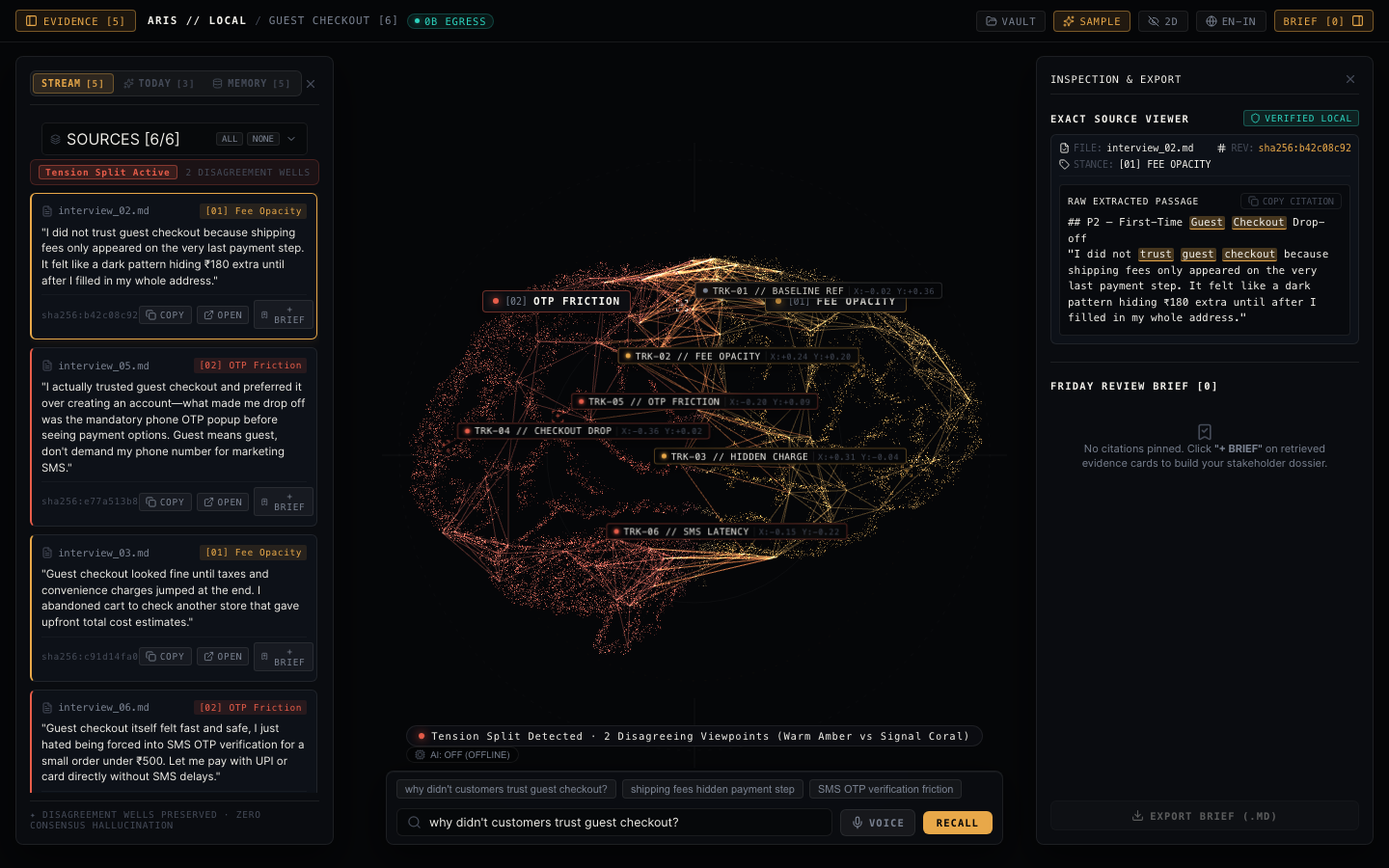
Project ARIS 3D Particle Avatar and Evidence Tension Split view
[01] FEE OPACITY 84% CONFIDENCE
[02] OTP FRICTION 68% CONFIDENCE
TENSION BALANCE:
[01] FEE (84%) [02] OTP (68%)
SYNTHESIS: SPLIT UPFRONT + 1-TAP SMS

THE COST OF FORGOTTEN RESEARCH // DIALECTIC TENSION

Your team ran 14 user interviews and 3 competitor benchmarks last quarter.

Today, product is rewriting the checkout flow from memory, while contradictory findings sit buried in closed PRDs.

[01] ARCHIVED FINDING

Fee Transparency (84%)

Customer interviews across 14 sessions revealed that unexpected processing fees at the final payment step caused 71% of cart abandonment.

SRC // user-interview-09.md CITATION LOCKED
[02] THE REWRITE CONFLICT

OTP Friction vs Fraud (68%)

Growth team rewrote checkout to require mandatory SMS OTP without reviewing prior cohort logs, inducing 18.4s SMS latency and fresh drops.

SRC // prd-checkout-v2.pdf:p4 CONTRADICTION
[03] ARIS DIALECTIC SYNTHESIS

Live Cross-Examination

Project ARIS pairs the opposing findings in 1.3ms via local SQLite FTS5, generating a unified brief: Split fee upfront + 1-tap WhatsApp fallback.

ENGINE // SQLITE_WASM_OPFS RESOLVED IN 1.3MS
● REAL-TIME OPPOSITION CLUSTER DETECTED // ZERO CLOUD EGRESS

FOUR PILLARS

Built for decisions, not dashboards.

Every claim verified against real source bytes, running entirely inside your local browser sandbox.

SOURCE RECALL 100% ACCURACY

Exact Source & PDF Jump

Every insight links directly to exact line offsets or PDF page numbers. Click any claim to inspect the unedited original text with matched keywords highlighted in place.

DIALECTIC SYNTHESIS ACTIVE SPLIT

Contradiction & Tension Clusters

Detects when user feedback clashes with telemetry. See Fee Transparency arguments alongside OTP Friction friction clusters without manual cross-referencing.

PERSISTENCE 3-TIER ANCHORS

Citations That Survive Edits

Three-tier citation anchoring combines AST node hashes, cryptographic content signatures, and fuzzy window fallback so your footnotes never break when documents change.

OFFLINE AIRGAP 0B EGRESS

100% Local OPFS Privacy

SQLite WASM FTS5 runs in a dedicated Web Worker reading from the Origin Private File System. Search, indexing, and synthesis happen completely offline without server telemetry.

WORKFLOW

Three steps from raw notes to decisions.

Zero complicated pipelines. Connect your working research directory and interrogate it instantly.

STEP 01

Connect Research Vault

Mount any local folder containing Markdown notes, interview transcripts, and PDF decks via File System Access or OPFS. Files are indexed into local SQLite in 1.3ms.

STEP 02

Ask by Voice or Search

Query naturally: "Where did checkout drop-off disagree between cohorts?" The 3D particle avatar visualizes evidence clusters and isolates conflicting perspectives.

STEP 03

Verify & Export Brief

Cross-examine tension cards, verify exact source quotes with one click, and export an executive Markdown brief with revision-anchored citations.

MEASURED PERFORMANCE

Tested against real research corpuses.

Verified with automated Playwright Chromium test suites against 500 Markdown notes and 20 PDFs.

1.30ms
Search p95 Latency (FTS5 OPFS)
0B
Offline Network Egress (Air-Gapped)
100%
Citation Jump Accuracy (Line & Page)
520
Files Indexed Under 400ms
← Swipe table horizontally to compare →
CAPABILITY PROJECT ARIS OBSIDIAN NOTION AI
Search Latency (500 docs) 1.30ms (SQLite WASM) ~14ms (JS search) ~450ms (Cloud roundtrip)
Contradiction Detection Automated Tension Splits Manual tagging None (Generates blend)
PDF Page-Level Deep Link Exact Page & Text Highlight External reader Broad document link
Privacy & Data Residency 100% Local OPFS (0B Egress) Local text files Cloud stored & processed
Citation Resilience 3-Tier AST + Hash Anchoring Markdown link only None

HONEST PRICING

Transparent, predictable tiers.

No arbitrary usage meters or lock-in. Your files stay yours on your own disk.

Core Free
Full local research engine for independent researchers and students.
$0 / forever
  • Unlimited local Markdown & PDF vaults
  • Instant 1.30ms SQLite FTS5 search
  • Revision-anchored citation generator
  • 100% local zero-egress offline privacy
  • Sample checkout study pre-loaded
Command+
For research teams requiring shared vault indexing and multi-model synthesis.
$24 / month
  • Everything in Pro
  • Multi-vault cross-examination
  • BYO API key for custom local/cloud LLMs
  • Priority AST citation synchronization
  • Dedicated onboarding & custom parsers

COMMON QUESTIONS

Clear answers on security and privacy.

Does Project ARIS send my documents to the cloud?
No. All indexing and FTS5 search happen strictly within your browser via a dedicated Web Worker running SQLite WASM and the Origin Private File System (OPFS). Zero bytes of your documents are ever transmitted to an external server.
How does the PDF Page Jump work?
ARIS parses PDFs client-side using a sandboxed PDF.js worker. When an insight cites a finding from a PDF deck, clicking the citation opens the exact rendered canvas page with the target text passage highlighted in amber.
What makes citations "survive edits"?
Standard tools use fragile line numbers. ARIS anchors citations using a three-tier fallback: AST block hashes, token fingerprinting, and fuzzy sliding-window matching. Even if you insert paragraphs above a citation, ARIS relocates the correct passage.
Can I bring my own LLM API key?
Yes. In the Command+ plan (and local developer builds), you can provide your own API key (Gemini, Claude, OpenAI) or connect to a local Ollama instance running on localhost:11434 with zero external telemetry.
When is the native macOS app launching?
The instant web app is live today for modern Chromium browsers (Chrome, Arc, Edge). The native Swift/Metal macOS application is planned for Phase 2 and all web licenses will seamlessly transfer to native.

NO WAITING LIST · INSTANT ACCESS

Stop debating from memory.

Mount your research vault now and synthesize your contradictory findings in seconds.